
What I’d Fix at ZoomInfo’s RevOps
Why AI changes where revenue intelligence creates value.
Why Is ZoomInfo Slowing?
Part I of two. Part II tests the hypothesis this piece ends on.
ZoomInfo owns one of the best proprietary datasets in B2B sales with information on contact graphs, intent signals, org-chart changes, and tech-stack diffs. The kind of data most GTM teams would still pay a premium for. And yet the company's growth has been flat for two years, its stock is down roughly 80% from its 2021 peak, and its own board just authorized another $1 billion in buybacks instead of reinvesting in growth.
That's the puzzle. A company with real proprietary data, in a market that still runs on outbound, that can't get back to growth. Either the data stopped mattering, or something else did. I spent time in ZoomInfo's own numbers to find out which.
Why ZoomInfo
I picked ZoomInfo because I know the product from the inside, not just from the outside. Seven years as an account executive at Oracle, Zendesk, HubSpot, and CYGNVS, a cybersecurity startup. Four different companies, four different sales motions, and ZoomInfo or a direct competitor in the stack at every one of them. I've opened the tool on a Monday morning under quota pressure and asked it to tell me who to call. I also had a separate RevOps teardown on the company already underway before I started this specific investigation, so I wasn't reading the 10-Q cold. I already had a point of view on where they win and lose deals.
That combination, real usage plus real numbers, is what makes this worth writing. A lot of "why is this company struggling" analysis is written by people who've never had to use the product to hit a number.
The Evidence
Here's what's actually in ZoomInfo's own filings and earnings releases, not speculation.
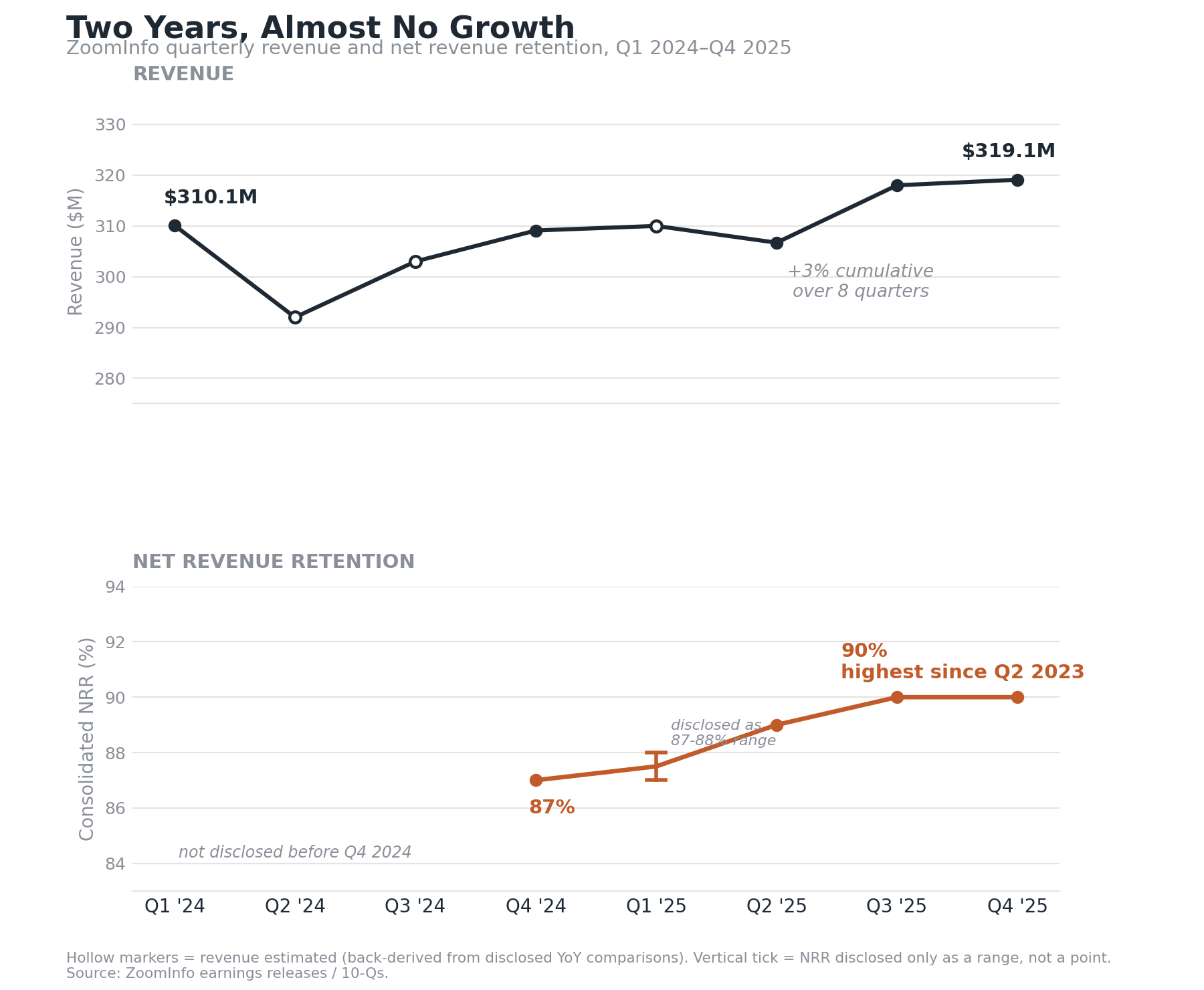
Revenue has been essentially flat for two years, from $310.1M in Q1 2024 to $319.1M in Q4 2025, roughly 3% cumulative growth across eight quarters. FY2026 guidance is around +1%. The stock is down about 80% from its 2021 high, the company rebranded its ticker from ZI to GTM during 2025, and the board authorized a fresh $1.0 billion buyback in February 2026 — capital going back to shareholders, not into a growth engine.
Net revenue retention has actually been climbing, 87% in Q4 2024 to 90% in Q4 2025, the highest it's been since Q2 2023. On its face, that reads like a business getting healthier.
But split the customer base and a different picture shows up.

Upmarket NRR sits at 100%. Downmarket revenue is contracting roughly 10% year over year. Upmarket's share of total ACV climbed from around 68–70% to 74% over the same stretch. Meanwhile, customers spending $100K+ grew only 3% year over year in count, while upmarket revenue itself grew 6%, spend per large account is rising faster than the number of large accounts is.
And ZoomInfo's own AI response, Copilot, now represents over 20% of total ACV in Q4 2025, more than double what it was a year earlier.
Everything above is in the filings. What follows is my read of it, and I want to be clear about where that line is, because it's the part someone could reasonably push back on.
My interpretation: the 90% consolidated NRR isn't a retention story. It's a mix-shift story. If your cheapest, fastest-churning customers leave the book while your stickiest customers, upmarket, retaining at 100%, become a bigger share of what's left, the blended average climbs even though nothing about retention quality actually improved anywhere. The ARPU pattern backs this up: big-account count is barely growing while big-account revenue grows faster, which looks like expansion and bundle pricing among customers who were staying anyway, not real net-new enterprise wins.
Read that way, ZoomInfo isn't recovering. It's consolidating around the customers who were never going to leave, while a different part of the business quietly empties out underneath the average.
This is where I move from reading the numbers to building an argument, and I want to flag that shift clearly. Everything past this point is a hypothesis, not a fact pulled from a filing.
My hypothesis: the customers leaving are disproportionately growth-stage SaaS sales orgs, the exact profile I sold into for years. That segment bought ZoomInfo for speed: fast contact data plus a workflow layer (Engage) to turn a signal into outbound within hours. That speed used to be defensible. It isn't anymore. Clay, Apollo, and LLM-driven enrichment now produce a comparable version of that same workflow at something like 5–10% of the cost. The switching cost that used to protect ZoomInfo, "our whole outbound motion runs through this tool", is exactly the layer the new tools are eating.
The customers staying, by contrast, are legacy enterprise sales orgs that bought ZoomInfo as something closer to a compliance-grade system of record, procurement, IT, and hundreds of seats already wired in. That's a real moat, and it's the one part of this business that isn't exposed.
So here's the split I think matters: ZoomInfo's actual proprietary asset, the contact graph, the intent data, the org-chart signal, still has real value. What's commoditizing is the generic workflow wrapped around it: sequencers, cadence tools, AI-written outreach, basic enrichment, anything a single rep can now buy and run themselves for almost nothing. Proprietary data remains durable. Generic workflow is becoming increasingly interchangeable. That split also explains why Copilot, ZoomInfo's own AI answer, still reads generic to a lot of the teams using it. In my view, that isn't a model problem, it's a context problem. It has access to proprietary external data, but it can't see an individual company's ICP definition, its closed-won language, or the objection patterns hidden inside its own CRM. Richer internal context, not simply a better model, is what closes that gap.
If that's right, ZoomInfo's growth problem isn't a demand problem. It's a value-layer problem, a bundle priced as one thing, where half of it (workflow) is being commoditized out from under the other half (data). And the part being commoditized isn't the part that was ever actually scarce.
The Bigger Pattern
I don't think this is really a ZoomInfo story anymore. I think ZoomInfo is just the clearest place to see something bigger happening across GTM software.
For a long time, the scarce resource in outbound was information. A good contact, a real signal, an accurate org chart, getting that took money and infrastructure, and companies like ZoomInfo built real businesses on owning that scarcity. AI-driven enrichment and research tools have made a version of that information close to free. Not perfect, not proprietary, but good enough that "we have better data than you" stopped being a durable pitch on its own.
What doesn't get commoditized as easily is the judgment sitting on top of that information: which signal, out of the dozen a rep could be looking at, actually matters right now. Which account, out of a thousand technically qualified ones, is worth a rep's next hour. What to say, and to whom, once an account is worth working. That judgment has historically lived entirely inside good reps' heads, inconsistent, unteachable, and gone the moment the rep leaves. It was never something a vendor could sell, because it was never a product. It was a skill.
That's the layer I think is moving now. Not from no signal to some signal, that shift already happened, over a decade ago, and companies like ZoomInfo won it. The shift happening now is from collecting signal to operationalizing judgment about signal: building the decision logic that determines what matters, how much it matters, and what action should follow. The goal is to make good decisions repeatable, auditable, and durable enough to survive a rep leaving instead of walking out the door with them.
The Operating Model Hypothesis
If that's the real shift, the implication is specific: the organizations that win the next few years of GTM won't be the ones with the best data feed. They'll be the ones that turn "which signals matter, and what do we do about them" into an actual system, explicit enough to audit, consistent enough to trust, durable enough to survive turnover, instead of leaving it as something a strong rep carries around and a weak rep never learns.
That's a real claim, and I don't think it's obvious how to prove it. Data is easy to point at, you can screenshot a contact record. Judgment isn't something you can screenshot. The only way to tell whether a system actually encodes judgment, rather than just moving data around faster, is to watch what it does when a real decision has to get made.
So that's the question I was left with. If judgment really is the scarce resource now, what would a system built to operationalize it actually look like, and would it hold up if I built one myself, against a real market, and watched where it broke?
To test that, I built one.
See the hypothesis in practice: Watch a 4-minute walkthrough of the AI-native account prioritization workflow that inspired this series.