Signal Over Noise
What a month of analyzing GTM roles taught me about making better decisions.
A few years ago, the hardest part of job searching was finding opportunities.
Today, it’s the opposite.
There are more job boards, more AI tools, more newsletters, more LinkedIn posts, and more “Top 10 Roles of the Future” lists than ever before.
Information is no longer scarce.
Attention is.
Ironically, having more information hasn’t made career decisions easier. It has made them harder.
Over the last month, I experienced this firsthand while participating in AlphaForge’s GTM Engineering Bootcamp. What started as a market research exercise became something much more valuable: a lesson in how to make better decisions when information is abundant.
When More Information Makes You Worse
Like most people, I naturally started with job titles.
Enterprise AE.
SMB AE.
Mid-Market AE.
That approach had worked throughout my sales career. Titles weren’t perfect, but they were usually good enough to understand what the job actually was.
Then I started researching GTM roles.
GTM Engineer.
Revenue Systems.
Business Systems.
Revenue Operations.
Commercial Operations.
Revenue AI.
Growth Operations.
On paper, they looked like completely different careers.
The more I read, the more confusing the market became.
The problem wasn’t that job titles were useless.
The problem was that I was treating them as strong signals when they were actually weak ones.
A title tells you how a company labels a role.
It doesn’t tell you:
- What problems you’ll solve.
- What systems you’ll own.
- Who you’ll work with.
- How success will be measured.
- Why the role exists in the first place.
As companies evolve faster than the market can standardize role names, titles change much faster than the underlying work.
The problem wasn’t having too little information.
It was paying attention to the wrong information.
Looking Backward Instead of Forward
One of our bootcamp projects challenged us to identify our wedge in the emerging GTM Engineering market.
Instead of starting with ourselves, we started with the market.
Each participant analyzed a different slice of GTM roles, looking beyond titles to responsibilities, outcomes, tools, and organizational context.
Individually, each analysis was useful.
Collectively, they became something much more interesting.
Across roughly thirty independent analyses, the same pattern kept emerging.
Companies were using very different titles to describe remarkably similar work.
The variation wasn’t random.
It reflected differences in organizational structure, company maturity, hiring philosophy, and internal language—not fundamentally different business problems.
That changed how I thought about evaluating opportunities.
Around the same time, Michael Nissan’s work helped map the emerging GTM Engineering landscape. Building on that foundation, our cohort explored a different question:
how much can you actually infer from a title alone?
Analyzing roughly 150 role mentions across the cohort suggested that some titles are highly predictive of the underlying work, while others require reading far beyond the label.

Caption: Rows are ordered by predictive value. Concentrated rows indicate trustworthy titles; dispersed rows indicate titles that require reading the responsibilities.
Different Labels. Same Problem.
One example stood out to me.
Clay
GTM Engineer
Design scalable customer workflows and improve GTM execution.
Moloco
GTM Strategy & Operations Manager
Improve commercial execution across teams.
Figma
Director, Business Systems
Build the internal systems that enable the business to scale.
If I had evaluated these roles by title alone, I would’ve assumed they represented three different career paths.
Once I ignored the titles and looked at the underlying work, they became remarkably similar.
Each role centered around the same underlying questions:
- How do we remove friction?
- How do we improve commercial execution?
- How do we help teams make better decisions?
- How do we build systems that scale?
The title told me where the role sat on the org chart.
The underlying work told me why the role existed.
That became the stronger signal.
A Better Framework
Today, I approach new markets differently.

- Inventory your career capital.
Start with the skills you’ve already developed and the business problems you’ve already solved. - Study the market.
Treat titles as hypotheses, not conclusions. Read past the label to understand the underlying work. - Look for recurring problems.
Don’t cluster roles by software or buzzwords.
Cluster them by the business problems companies are trying to solve. - Organize the evidence.
Group similar responsibilities, outcomes, and systems together.
Patterns emerge much faster than titles suggest. - Find your wedge.
Look for the overlap between:
- Your existing strengths.
- What the market consistently values.
- Where you want to continue growing.
That’s a much stronger foundation than chasing the newest job title.
This Was Never Really About Careers
The more I reflected on this market analysis, the more I realized it wasn’t really about job searching.
It was about systems thinking.
During the same bootcamp, I built an Account Prioritization Engine.
Laying that process next to how I’d just evaluated the job market made something obvious that I’d missed while living through both separately.
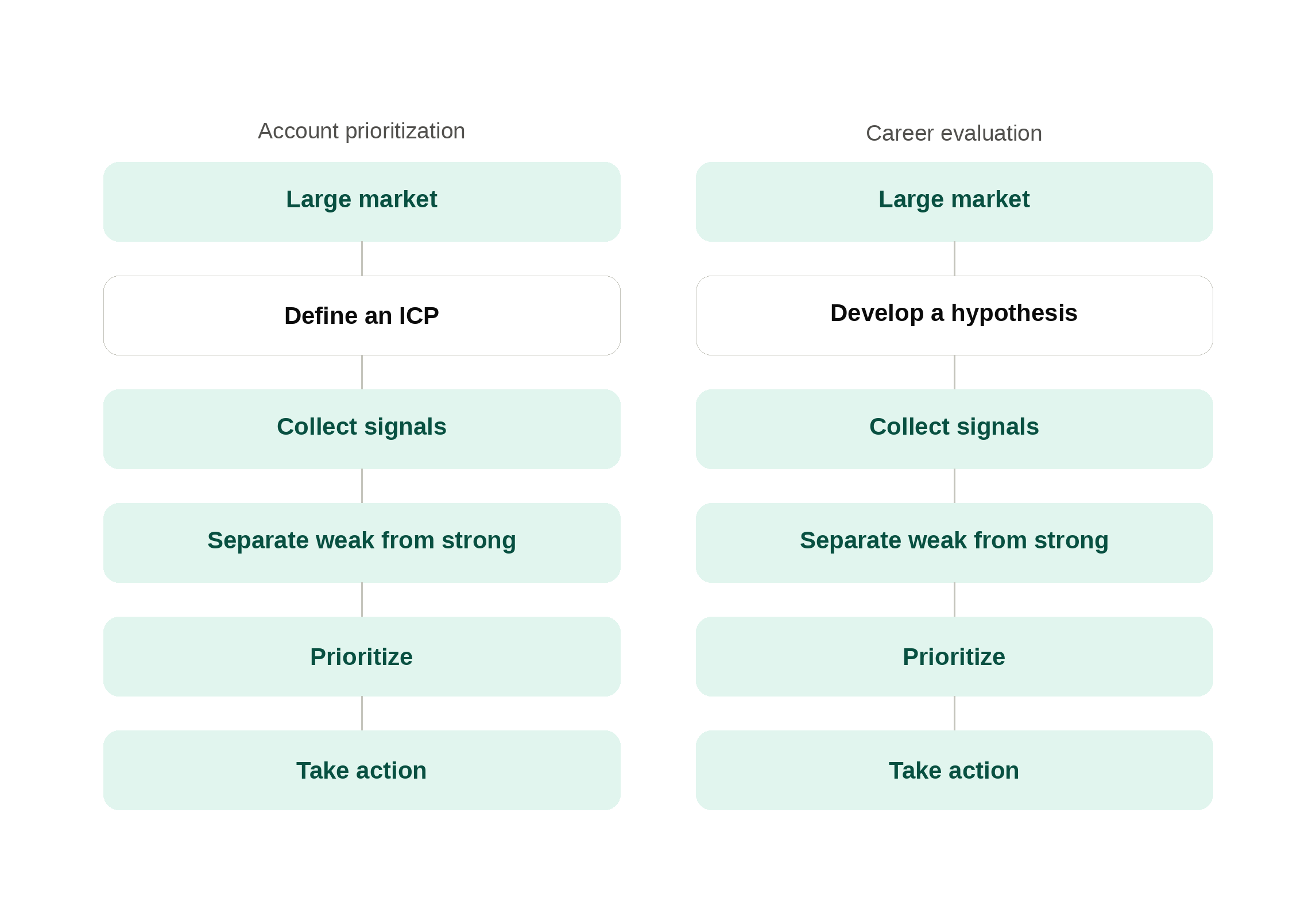
Caption: Five of the six steps are identical. The only difference is how the process begins: a market definition versus a personal hypothesis. Everything downstream follows the same decision-making discipline.
Both require making decisions under uncertainty.
Both reward judgment over information.
Both improve when stronger signals are identified earlier in the process.
Whether you’re evaluating accounts or careers, the challenge isn’t collecting more information.
It’s learning which signals deserve the most weight.
The more I analyzed the market, the less interested I became in job titles and the more interested I became in organizational problems.
Closing
Four weeks ago, I thought I was searching for the right role.
Now I think I was searching for the right problems to solve.
The title was never the decision.
It was simply one signal among many. It wasn’t a particularly strong one.
In a world where information is becoming increasingly abundant, I think this lesson extends far beyond job searching.
The people who consistently make better decisions won’t be the ones with the most information.
They’ll be the ones who become better at recognizing which signals actually matter.